
The traits that matter most to a breeding program are often the most expensive to measure, so they are measured on a small subset of candidates. The rest of the population is selected on less information than it deserves, and genetic gain is capped by phenotyping cost.
PhenoScale flights across the whole population capture Green Cover, Mean Plant Height, Senescence, Flower Fraction and Maturity Date on every plot. Cloverfield links these secondary traits to the reference measurements available on the subset and calibrates the predictive relationship.
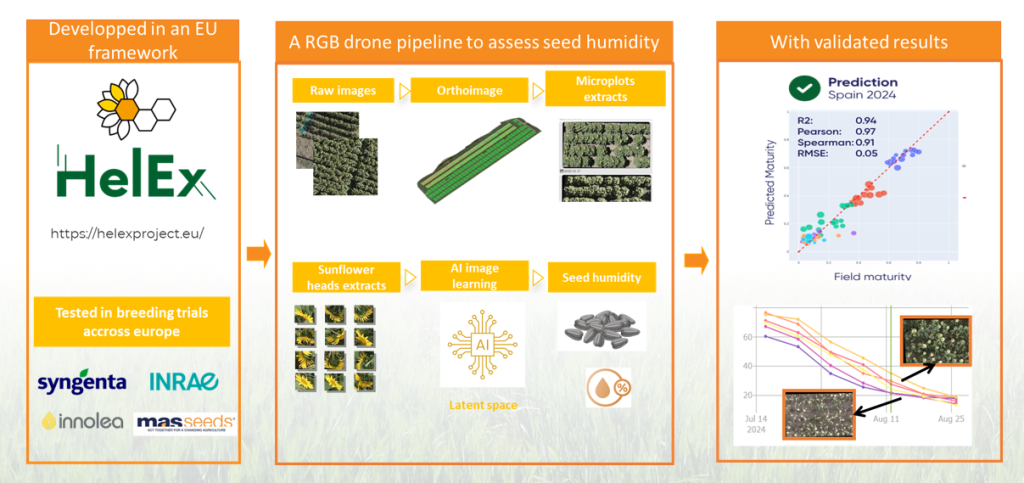
The same approach extends to traits no sensor measures directly. Within the HelEx collaborative project, a deep-learning model estimates sunflower seed moisture from drone RGB imagery; flights repeated through the cycle build a dry-down curve per genotype on every plot and across locations, to select for yield stability and align harvest with physiological maturity, with no destructive sampling.
Breeding values can then be estimated for candidates that were never measured directly, extending selection to far larger populations at a fraction of the phenotyping cost. Developed on maize with a public research program and on sunflower within HelEx, and applicable to wheat and soybean.