In this fifth episode of our series of CAPTE videos, Joss Gillet (R&D Director at Hiphen) asks Benoît De Solan (CAPTE Team Manager, Arvalis) about plant phenotyping acquisition systems. They discuss what makes DJI UAV (drone) equipment well suited for crop experiments and monitoring.
This is particularly topical as DJI unveiled today during the Airworks 2019 event the launch of its P4 Multispectral drone developed specifically for precision agriculture applications. An exciting news which will continue to democratize the use of remote sensing technology for crop management. It is maybe the first time we witness a global drone manufacturer bringing forward their ability to compute NDVI – a basic vegetation index Hiphen and its partners and clients have been manipulating for years.
As such, Benoit De Solan explains that drones such as the DJI Mavic 2 Pro or Matrice 200/210 series are now widely used in the agricultural sectors mainly because of their high-throughput performance and value-for-money. Drones are indeed transforming plant phenotyping applications, allowing field operators to collect in a few UAV flights what used to take months to measure manually – something we discuss in more depth in this video blog.
The Mavic 2 Pro is indeed an affordable high-throughput acquisition system that was not initially made for our plant phenotyping activities, but instead aimed more at movie making activities. Yet the high quality data delivered by such device is well suited for our smart farming needs, and given the latest DJI annoucements in this field, we can expect a rapid growth in the use of drones for agtech use cases.
You can read more on DJI website about other drone applications such as crop consulting, irrigation management, crop inspection or spraying – with the Agras T16 unveiled at Airworks 2019 and made specifically for spraying and to "revolutionize the way farmers work".

At Hiphen and CAPTE, we have gathered an extensive experience in using drones for precision agriculture applications, and we would be delighted to tell you more about whether you should in-house or outsource such skills, which UAV equipment and sensors to select, how to best prepare your UAV flight plans and what type of traits you can expect in return. All of these are questions that our clients are now very familiar with and we are looking forward to discussing these topics with you.
As always, feel free to reach out to us at contact@hiphen-plant.com.
In this fourth episode of a series of CAPTE videos, Alexis from Hiphen asks Professor Frédéric Baret from INRAE EMMAH to describe the type of plant phenotyping traits and indicators we can compute using UAV (drones). But first of all, if you don't know what an agronomic trait is, check out our dedicated post HERE.
Professor Baret explains that we can group these traits in three classes:
With the first class of traits, we are indeed measuring traits related to the canopy structure like the amount of leaves, or the amount of light intercepted by the crop that can then be transformed into biomass. With the second category of traits, we are aiming at characterizing the biochemical composition of the plants which is very interesting for instance for the chlorophyll content since it is closely related to the nitrogen intake of the plant.
Finally, disease symptoms and plant stress can indeed be measured with different methods in order to understand if the crop is growing under good conditions of if some stress factors are limiting its development such as water or thermal stresses.
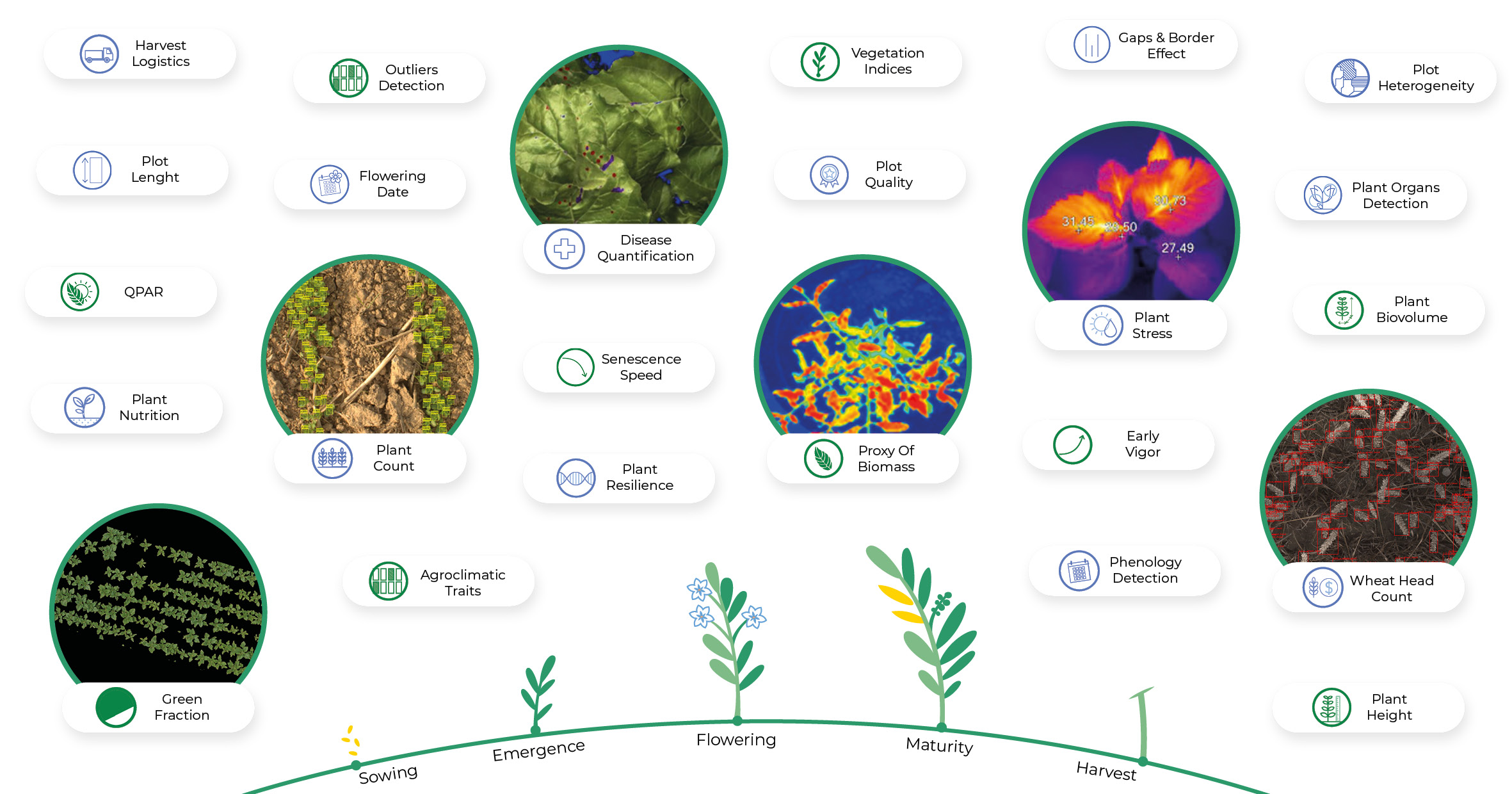
At Hiphen we have developed a catalogue of traits based on methods that we continuously challenge and improve within the CAPTE research unit. We can therefore offer a robust set of high-value traits and indicators, while being very creative to compute new ones – either as technology evolves, or because our clients request very specific traits.
We would be delighted to tell you more about our traits catalogue, so do not hesitate to get in touch with at contact@hiphen-plant.com to ask questions and see how we could support your projects.
We look forward to hearing from you.
Keep safe,
Your Hiphen Team.
In this third episode of our series of CAPTE videos, Alexis from Hiphen asks Professor Frédédric Baret from INRA EMMAH to provide an overview of the remote sensing technology for plant phenotyping.
Professor Baret explains that there are different types of sensors that can be mounted on various vehicles, showing that there is not a one-size-fits-all solution but rather a range of technology suitable for different traits, applications, crops, budgets, etc.
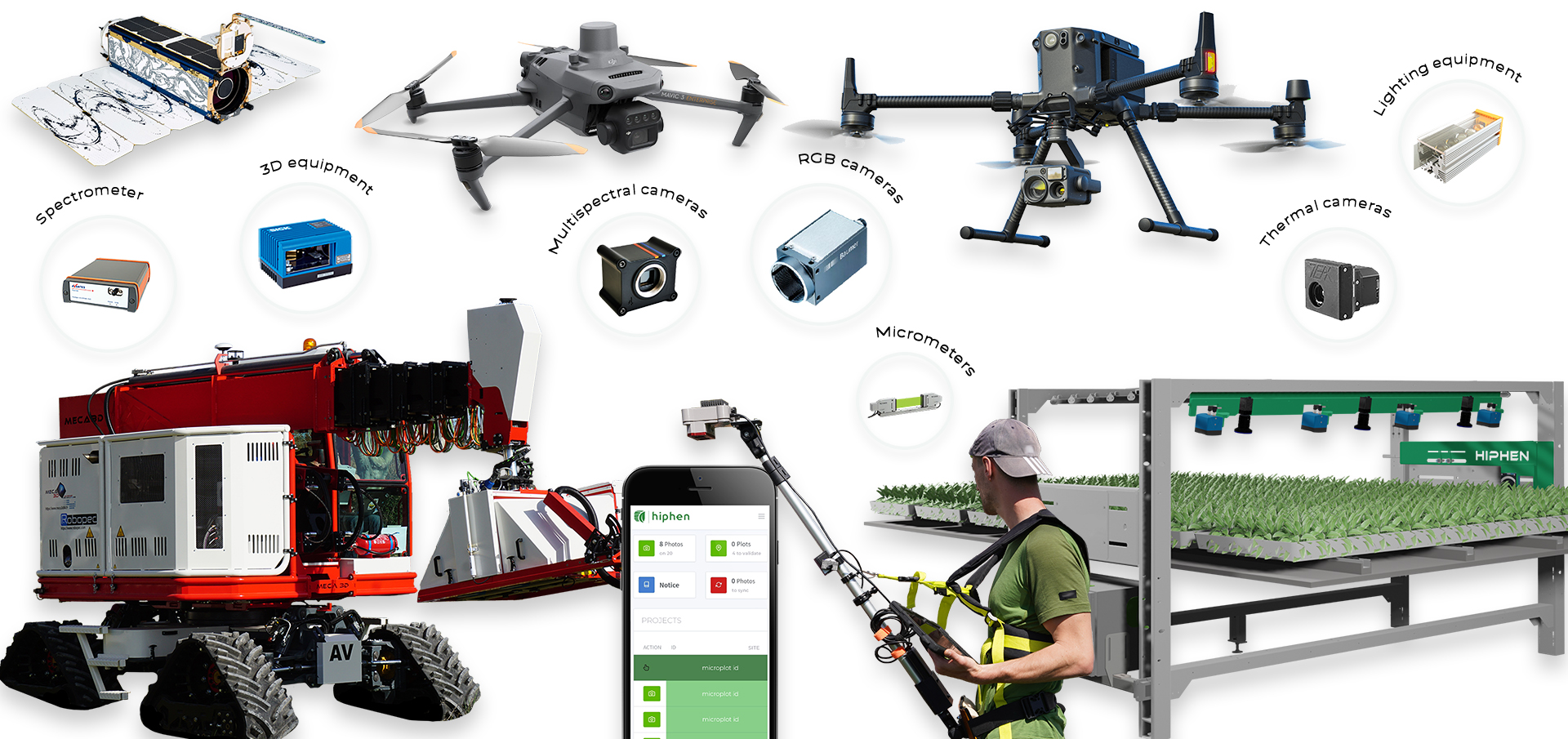
Among the sensors presented in this episode, you will hear about the RGB or multipsectral cameras such as the Airphen camera developed by Hiphen and CAPTE members. These cameras present a range of advantages from high-resolution images that help to characterize the structure of the canopy, plant organs and detect diseases, all the way to assessing the biochemical composition of the plants – such as its chlorophyll content. LiDAR is also used to reconstruct in 3D the structure of the canopy in order to derive important traits such as plant height.
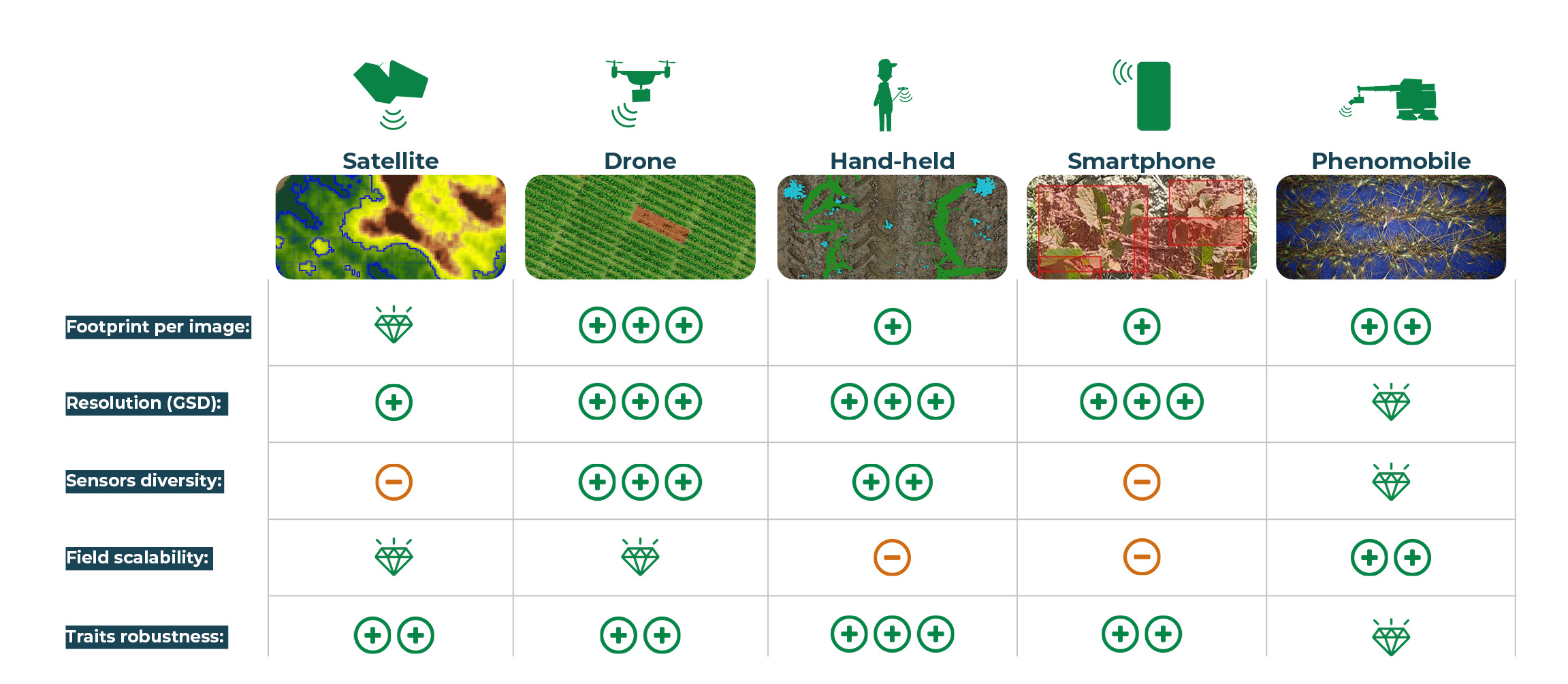
In parallel, these sensors can be mounted onto various vehicles from UAV (drones) to automated robots – called Phenomobile and handheld devices such as "Literal". As highlighted in this video, these vehicles present different strength and weaknesses. For instance, while UAV allows us to reach very high-throughput, the resolution it renders can vary from medium to high resolution. In contrast, a Phenomobile provides very high resolution and very accurate measurements, while being able to adapt to various environmental conditions thanks to its embedded flashes.
At Hiphen, our philosophy is that remote sensing technology for plant phenotyping has to be tailor made to your project. So, your application will require either one type of system, or a combinaison of sensors and vehicles. This really depends on your crop, the traits you are interested in, etc. That is why we always put forward our expertise in data fusion, and the range of technology, hardware and equipment that we offer our clients will continue to evolve as technology and methods keep improving.
Should you wish to learn more about our solutions can best support your business, please get in touch by email at contact@hiphen-plant.com. Lastly, feel free to consult our scientific papers archive that contains tones of information about phenotyping technology and methods we developed over the past years at CAPTE.
We look forward to hearing from you.
Sincerely,
Your Hiphen Team.
Hiphen was awarded funding through the EU DIVA program for its innovative project on High-throughput Phenotyping for Biorationals in Arable crops [HiPheBia]. The efficacy of biorationals for arable crops is difficult to establish in open field crops due to the product’s characteristics and the field assessment methodology constraints. Thanks to our partners Eurofins Agroscience Services and Certis France, this project aims at developing a prototype of an innovative, high-throughput phenotyping service to evaluate their efficacy in arable crops, especially against Fusarium on wheat.
Biorationals are crop protection products based on natural compounds, they can contribute to the sustainable intensification of agriculture. Globally, the biorational market is growing at two-digit growth and offers great perspectives. However, for arable crops, not many biorationals are registered for use and available to European farmers because the efficacy of these products is difficult to establish in open field crops, due to product characteristics and to constraints of methodology for the field researchers.
HiPheBiA- High-throughput Phenotyping for Biorationals in Arable crops- aims at developing an innovative phenotyping service dedicated to the field efficacy evaluation of biorational solutions against pests and pathogens in arable crops. Our one-stop solution will integrate new imagery data automatically processed through algorithms with other field-related agronomic and climatic information. The final outcome will be a comprehensive efficacy assessment of the biorational solution in its field context.
In this project we will first elaborate a prototype of the service for biorational field experiments against Fusarium sp in Wheat. Field experiments will be provided by our partner Eurofins Agroscience Services, a registered DIVA demonstration site and potential end-user of our solution.
With our solution, our end-users will be able to enlarge their field experiments and collect more data with a guarantee of standardization, quality and traceability. Moreover, they will be able to evaluate the global efficacy of a biorational within its agro-system, as we will integrate the complex agro-pedo-climatic interactions as well as the indirect environmental benefits of biorationals into our advanced deep learning analytics. This will improve the whole agro value chain as more biorational solutions will be available for use in arable crops, contributing to a safer and more sustainable agriculture using less chemical pesticides.
Thank you all for your interest in our solutions and to our partners for their trust. We are looking forward to presenting you the results of this project.
Keep safe.
In this second webinar, Alexis Comar (Founder and CEO at Hiphen) meets with Rachel Maire (Sales Lead at Planet) to discuss how the Hiphen-Planet satellite solution offers great opportunities for plant breeders, farming companies, cooperatives, and other agro-industrial actors.
The webinar covers three main use cases:
We hope that you enjoy this webinar and, as always, do not hesitate to get in touch with us should you have any questions or require any assistance with your plant phenotyping and crop monitoring projects.
Hiphen is proud to announce the launch of its partnership with Planet Labs, a leading satellite imagery provider with whom we are looking to enhance the range of solutions available to the agriculture sector – from plant breeders to farmers, cooperatives and agro-industrial actors.
Planet has launched satellite constellations such as PlanetScope (2009) and SkySat (2014) that today encompass more than 150 satellites in orbit that are able to image anywhere on Earth daily at 3 meter and 72 centimeter resolution. Using Planet's API and online tools, you can access 360M+ sq km of daily imagery to monitor extensive and distributed areas of interest (AOI), and analyze trends with PlanetScope and SkySat archives.
Planet believes that space can help life on earth. Today's agriculture falls into this vision and we are making change visible thanks our near daily imagery. Hiphen's applications and expertise can leverage this information into valuable insights at the speed of change. As such Hiphen has developed robust methods to deliver daily field imagery by constantly seeking means to merge satellite imagery with sensors and with the latest advancement in crop science in order to deliver always greater value to all players across the agri-sector.
Through this partnership, both companies can leverage their technology and expertise to provide a new dimension to precision agriculture applications – that so far where essentially relying on legacy methods and tools such as Sentinel-2 (with a 10 meter resolution, and a 5-days revisit frequency). While Sentinel-2 remains a valuable asset to the agriculture sector, at Hiphen we believe that the information that we can deliver with Planet is set to augment and improve these methods – adding value to many actors in the sector and opening new perspectives to academics.
On November 7th 2019, Hiphen and Planet will be hosting a webinar that we encourage you to join to hear about the advantages behind this partnership and ask any burning questions. At this event, we will notably cover some of the hot use cases that we believe will change the game, notably explaining how plant breeders can leverage the Hiphen-Planet solution to monitor field experiments, or how we can help to improve support management tools for agro-industrial actors.
We look forward to answering your questions at this webinar.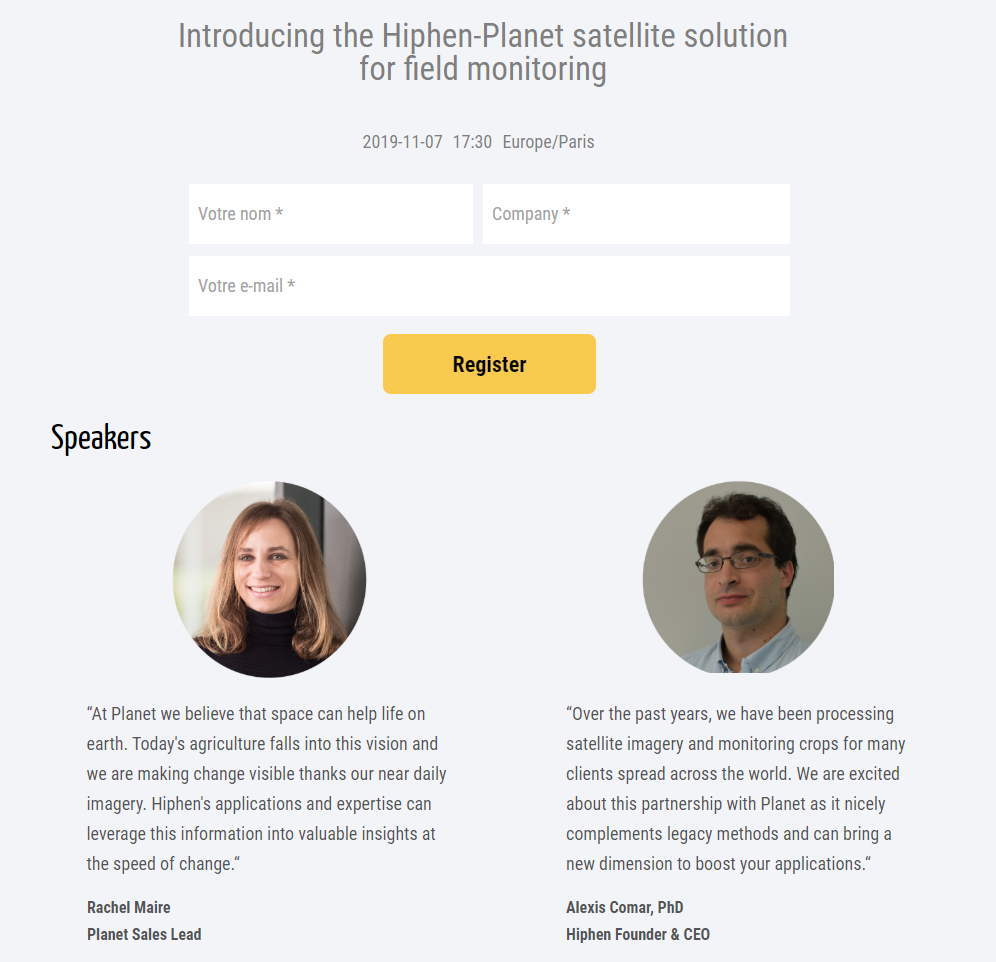
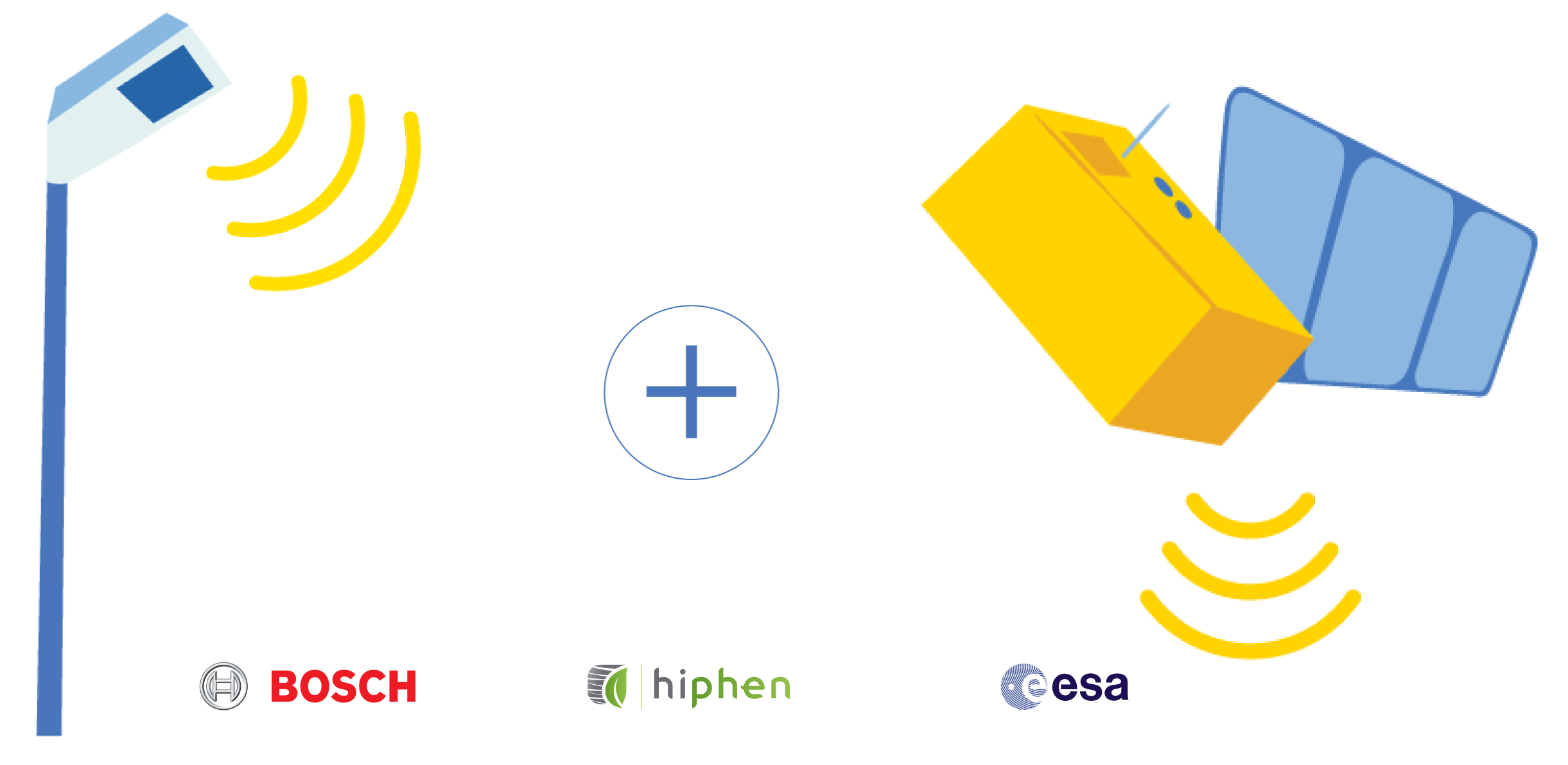
In this episode of a series of CAPTE videos, Alexis and Wenjuan from Hiphen discuss the value behind the fusion of satellite and IOT data.
Wenjuan notably explains that data fusion allows us to provide daily satellite imagery of the fields during the entire crop growing season. This is particularly important for farmers who want to monitor their fields in near real-time in order to best manage their crops – especially during key phenological stages.
Satellite imagery from Sentinel-2 is typically available every five days, unless clouds are present in which case you could have several weeks without data. This issue makes you 'data blind' during this period, which might be okay if you monitor a handful of fields located in the same region, but definitely not acceptable if you have to monitor hundreds of large fields spread across one (or more) country.
To fill in the data gaps for the periods where clouds made us 'data blind' we use IOT Field Sensors manufactured by Bosch in order to get a real-time eye in the field. The IOT sensors are placed in strategic stationary locations in the field (dependent on the pre-study of the field heterogeneity), and these IOT data inputs are extrapolated to be spatialized at the entire field level using satellite data. Thus, delivering a daily map of the fields.
Several biophysical indicators can be derived such as Leaf Area Index, NDVI (a proxy linked to the quantity of vegetation), CIgreen (a proxy of chlorophyll content) and others. The direct inputs from the satellite-IOT data fusion are then used for different applications ranging from crop management (fertilization, irrigation), yield assessments, and early warning systems inclusive of disease symptoms detection and phenologycal events detection.
As always, we would be delighted to tell you more about this type of solution and how they could potentially fit your agtech strategy. We look forward to hearing from you.
As consumers in many parts of the world are demanding a verifiable evidence of food traceability, actors across the agriculture sectors are looking for innovative solutions to build tools and mechanisms to reach greater transparency at all levels. At Hiphen, we believe that one way to potentially solve this challenge is by improving the link between farm and distribution with the help of IOT sensors.
As such, improving the link between farm and distribution can not only support the sector's objectives around food traceability, it can also support both sides in better negotiating contracts, better coordinating crop management, planning harvest logistics, and so on.
In France, a study conducted in 2017 by INRA and CLVC, showed that 97% of people interviewed request more information on the origin of the ingredients they are buying. In this context, one vision could be that – in the not so distant future – consumers could scan their product and see from which farm it comes from, when the crop has been sowed, harvested or transformed, if the plants suffered from any stresses during their development cycle, and how the farmer took care of them.
IOT sensors could play an important role in achieving this vision. The IOT Field Sensors™ co-developed by Bosch and Hiphen collect in almost real-time the type of data inputs that could inform such crop monitoring demands.
Over the past few years, Field Sensors™ have been installed and tested across various crops, projects and countries, collecting data on a daily basis about plant health. The daily images we collect from a single field are firstly used by the technicians to remotely monitor the development of the crop and take action in case a biotic or abiotic stress is detected for instance. Yet, their appications van go way beyond crop that example as, in some projects, IOT devices (which are loaded with sensors) are used to inform crop models aimed at managing fertilization and/or at improving yield prediction among other things.
The type of information collected and processed through the Field Sensors™ provide the level of transparency that not only help to improve the link between farm and distribution, but it also supports a vision in which this link could extend all the way to the consumer.
We would be delighted to tell you more about the amazing Bosch-Hiphen collaboration that led to the development of Field Sensors, and how these powerful devices could potentially support your business goals and field applications.
Please feel free to get in touch with us by email at contact@hiphen-plant.com
We look forward to hearing from you.
High-throughput plant phenotyping is gaining momentum each year among the entire agro-industrial sector and particularly among plant breeders. At Hiphen, we spent the past five years in fields and trial microplots, conducting smart farming experiments or simply flying drones routinely for clients demanding high-value agronomic traits. One of the many lessons we learned over the years is that one cannot pay enough attention to the UAV flight plan.
Too many times we heard companies coming to us to say, 'we need your help, the data we collected is not usable because the images are too blurred ' … or 'we did not use enough ground control points ' … or 'the multispectral images registration failed '.
Most often, we noticed that it is due to the selection of inadequate sensors or an inappropriate set of flight parameters. This is where Hiphen can start to add value in that we are here to support you in getting your UAV plans right from Day1, thus ensuring that your dataset will be usable in the end. Given the large budgets involved in phenotyping campaigns, this is worth considering indeed.

That valuable UAV flight checklist we provide each client with contains more than 20 critical drone and sensor parameters that we define together, by listening to your objectives and constraints. Together, we will review the drone and sensors required based on your budget, based on the traits you are interested in and based on the phenologycal stage at which to acquire the information. Then will follow the set of recommendations in the checklist concerning the appropriate flight altitude, front- and side-overlap, ground sampling distance, time of acquisition, sensor orientation, ground control points, radiometric targets, data structure and upload, and so on.
Your team of drone operators will only have to refer to this simple document when setting up their flight plan in the UAV tablet app, wherever they are in the world – ensuring consistency and quality across datasets. This will be one of the worries we can lift off your shoulders.
We have indeed developed this set of data acquisition protocols and checklist – often referred to as Standard Operating Procedures (SOP) – to make life easier for you and your team, to ensure data quality, and to support you in training your technical staff.
The digital revolution brought by high-throughput plant phenotyping often requires leading agro-companies to in-house new skills. One experienced breeder might be facing the challenge to have to hire a UAV operator to fly drones in several fields across several countries during the entire campaign – something rather unthinkable just a few years ago.
Our clients deciding to in-house data acquisition can benefit from training sessions provided by our experienced UAV operators who guide your technical staff towards the best tactics and methods to to do a fine job at acquiring data (including common mistakes to avoid). The same applies to our partners that decide to outsource data acquisition and need our help to train the third-party they subcontracted to (most of the time not versed in the use of drones for agriculture applications).
Our philosophy goes way beyond just flying a drone, and if you would like to hear more about it and get your very own UAV flight checklist, please get in touch by email at contact@hiphen-plant.com. Lastly, feel free to consult our scientific paper archive that contains tones of information about UAV methods we developed over the past years at CAPTE.
We look forward to hearing from you.
Photo credit: ©Thomas O'Brien – VPA
In this first episode, Alexis Comar (Hiphen Founder & CEO) asks Professor Frédéric Baret (Research Director at INRA EMMAH) about the purpose of UMT CAPTE.
UMT CAPTE is a scientific research unit based in Avignon (France) and specialised in developing methods and technologies for high-throughput plant phenotyping applications. The state-of-the-art technology and precision tools developed at UMT CAPTE help to overcome agricultural and environmental challenges faced by the actors within the agriculture industry.
The strength of this research unit lies in the close collaboration between Technical Institutes such as Arvalis, Hiphen (a privately-owned company) and the French National Institute for Agricultural Research (INRA).
Associate partners include: Terres Inovia, ITB, CTIFL, Geves and ACTA.
UMT CAPTE was created in January 2013 and is approved by the French Ministry of Agriculture and Food to develop tools and methods for an efficient use of sensors and remote sensing in agriculture.
As such, CAPTE stands for "CAPteurs (sensors) et TELedectection (remote sensing)".
To learn more about the projects led by CAPTE members, and the methods and solutions we introduced, please visit our CAPTE website or contact us at contact@hiphen-plant.com. A list of the 40+ scientific papers we published since our inception is also available in our archive.