
Note: This is a video-only post. The original article body contains only an embedded YouTube video (https://www.youtube.com/watch?v=E-40rFdCJ8U) and no text content.
Note: This is a video-only post. The original article body contains only an embedded YouTube video (https://www.youtube.com/watch?v=R8rOS34u9yU) and no text content.
Note: This is a video-only post. The original article body contains only an embedded YouTube video (https://www.youtube.com/watch?v=vZ6SxRHf9io) and no text content.
In this webinar, Joss Gillet (R&D Director at Hiphen) meets with Professor Frédéric Baret (Research Director at INRA EMMAH) to present how to get the most value from UAV plant phenotyping. The presentation runs for circa 20 minutes followed by a Q&A session with a large international audience.

The webinar covers three main pillars:
We hope that you will enjoy this webinar on how to get value from UAV plant phenotyping! And, as always, do not hesitate to get in touch with us should you have any questions or require any assistance with your plant phenotyping and crop monitoring projects.
Discover also our article introducing the plant phenotyping traits that we can compute using drones HERE.
This is a video post. Watch the video on Hiphen's YouTube channel.
This is a video post. Watch the video on Hiphen's YouTube channel.
Video-only webinar post. Watch the recording: Introducing the Hiphen-Planet satellite solution for field monitoring (YouTube video Z-VGrfVCk_0).
In this second episode of our series of CAPTE videos, Alexis from Hiphen asks Professor Frédéric Baret from INRA EMMAH about high-throughput plant phenotyping and its importance for the agriculture ecosystem.
Professor Baret defines plant phenotyping as the science of the characterization of the crops which is particularly important for decision support in agriculture and for plant breeders when selecting the best genotypes that will become the future cultivars well-adapted to different environments. As such, plant phenotyping helps to better understand the functioning of the crops, and this type of informations is often used to calibrate crop models.
In the past, the classical method used for phenotyping was labour intensive as it required an army of experts in the field to score plant samples, record plant characteristics manually (e.g. plant height) and often to retrieve (and thus destruct) plant samples in order to run tests in labs. This approach was therefore limited by its throughput which impacted data accuracy and it limited the number of traits for the characteristics that we extract from the plants.
Nowadays, non-destructive high-throughput methods are used to characterize the plants allowing us to record in a couple of hours what used to take field experts months to collect. Data acquisition technology using UAV (drone), satellite, phenomobile, handheld devices and AI-based algorithms now allow experts to spend more time analysing the results and efficiently making decisions instead of spending most of their time on the ground manually measuring plants.
High-throughput plant phenotyping can be achieved at a very large scale indeed. Most of our clients tend to scan on a single date multiple fields and trials from different locations globally, sending us the data remotely the next day and getting traits and results back in a matter of hours or days. In that sense, plant phenotyping is revolutionary and we believe that any actors in the agriculture sector can benefit from it as a wide range of data acquisition equipment and methods exist at Hiphen to adapt to your needs, budget, crops and required traits.
If you would like to hear more about it or should you have any questions, do not hesitate to get in touch with us via email at contact@hiphen-plant.com or by phone at +33784143163. Lastly, feel free to visit our scientific papers archive should you seek more details about the methods and techniques we develop at CAPTE.
This is a video post. Watch the video on Hiphen's YouTube channel.
In this seventh episode of a series of CAPTE videos, Joss Gillet from Hiphen and Samuel Thomas from Arvalis talk about Cloverfield, our online data processing engine built to automate the processing of plant phenotyping datasets.
Samuel explains that our data platform is built on a secure cloud-based architecture running on Amazon Web Services and docker technology to efficiently assemble and trigger the various algorithms required to process specific agronomic traits for our clients.
This online tool can process data acquired from any sensors, such as UAV (drone), Phenomobile, satellite, IOT and handheld devices such as Literal. This type of data engine is critical for any agro-actors such as plant breeders, farmers and cooperatives that have large fields or microplot trials spread across vast regions across the world. For them, it is very costly to compute all the data acquired on their fields and trials, and results tend to take a long time to be delivered. In addition, it often limits the amount of data clients think they can acquire, and they tend to prioritize certain fields or trial experiments to the detriment of others because processing too much data was up to now almost impossible, too expensive or would have required to in-house technical skills that would have made the task daunting.
First of all, Cloverfield allow to collect crops images after the data acquisition. After that, the automated data processing starts to run thanks to our algorithms and deep learning techniques. Then once the processing is finished, the next step is data visualisation as you can browse the agronomic traits computed very intuitively on the field map.
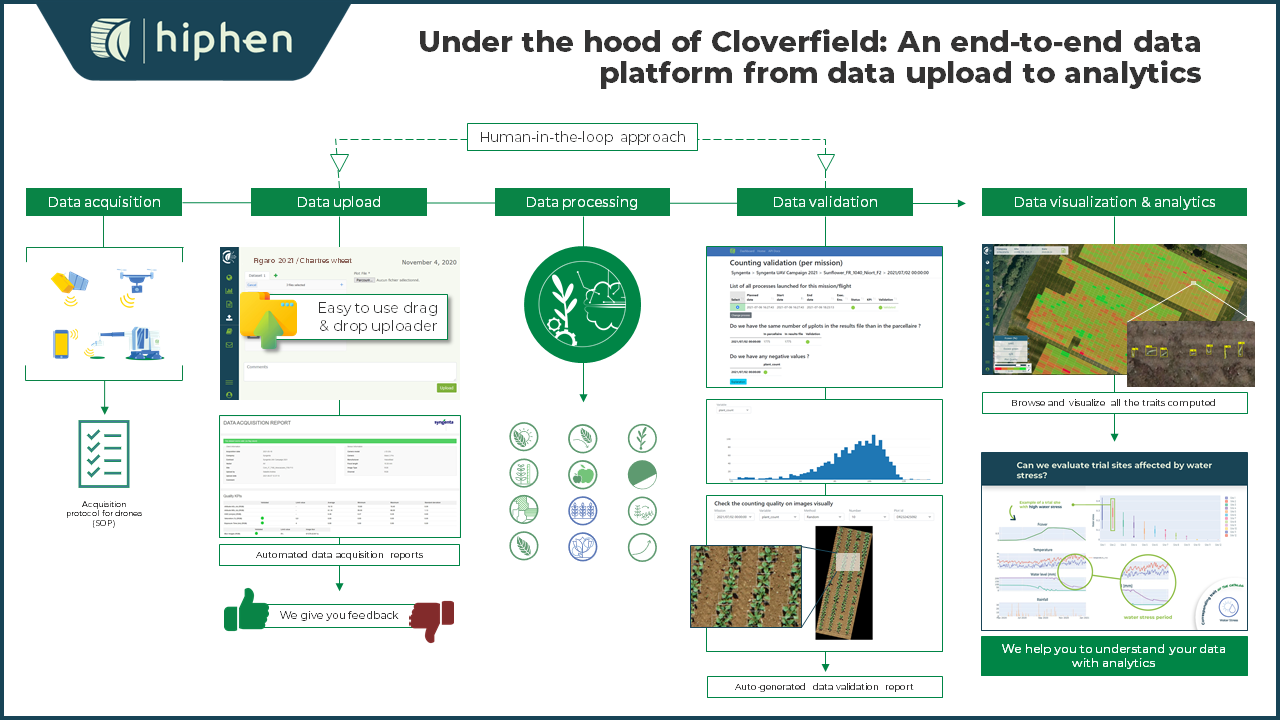
Under the hood of Cloverfield
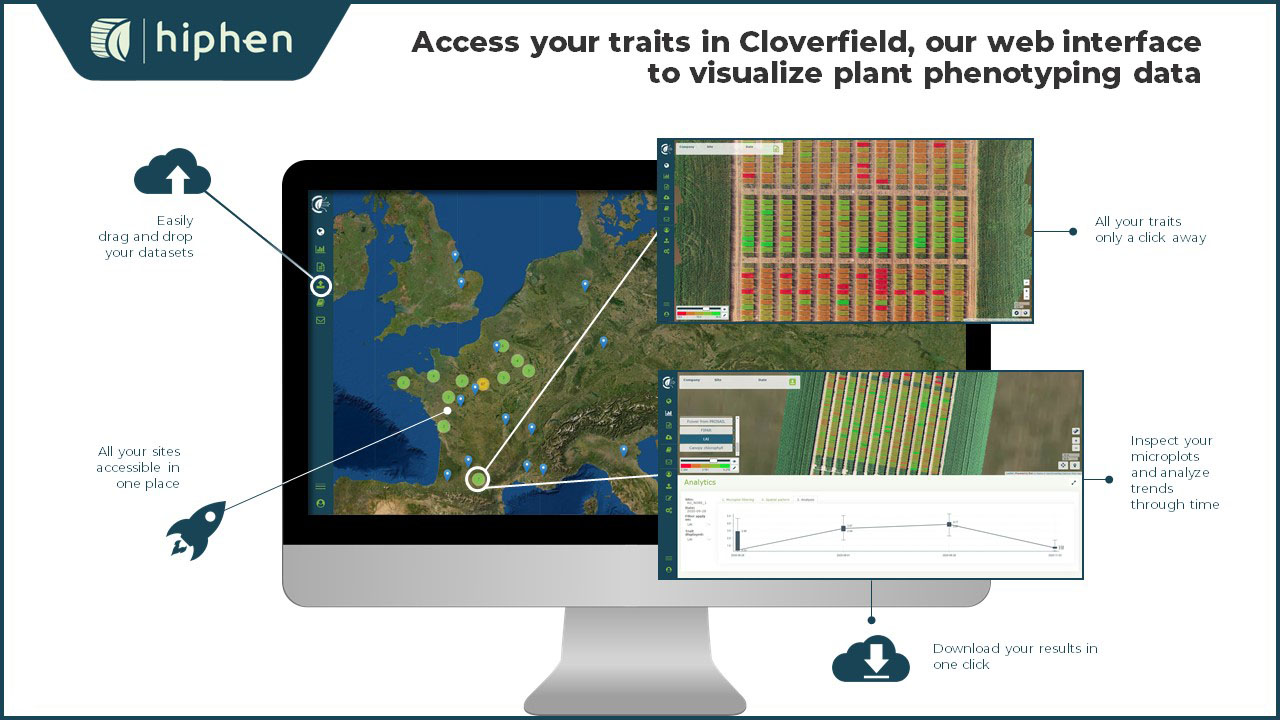
Cloverfield user interface
Cloverfield removes all these barriers and brings a new dimension to the plant measurements and phenotyping ecosystem, allowing users to concentrate on acquiring data, knowing that with our solution we can process large volume of data in a matter of days. The tool is flexible enough to accomodate for the specific agronomic traits selected by the client, but it can also deliver direct or intermediary outputs such as raw images, co-registered images, orthomosaics, microplot extractions, etc.
We use Cloverfield to deliver global contracts for our clients, ranging from plant breeders to agro-industrial actors with an international footprint. For instance, we receive UAV data all year long from countries in the Americas to Europe and Asia that Cloverfield can then process in a very timely manner.
Do not hesitate to get in touch with us should you wish to learn more about Cloverfield and how to gain access to it. We look forward to hearing from you.